Tuesday, May 10, 2022

May 10, 2022 - General Chapter 46

Today we moved into a new phase of the discernment process at the General Chapter. The "Challenges" that were combined last evening by the Secretaries of the language groups would be revealed, and a hushed anticipation reflected our interest. The statement was projected on the screen behind the dais, along with the "Conditions" that had been similarly combined.

(This is just a nice photo of a Brother making a phone call outside.)

The task now was to consider, discuss, amend, and approve these statements separately. This was a challenge because the approved process for doing so was cumbersome, limited, and not very user friendly. We were told that we could only ask questions for clarification, which was to be expected, and after that - and right after that - to propose amendments, each of which required a second by a member of the asembly, and each  of which would be immediately voted on after questions of clarification. There was clearly a time element at play. But before I could sufficiently read the run-on sentence to make some sense out of it, we were required to amend it and vote on it. There was really little or no time to reflect on the statement, sit with it a while, and perhaps suggest some elements for change.

There followed a painful (my assessment) 90 minutes during which the Moderators bravely followed the established protocols. There was no general discussion of concerns or amendments, because the time did not allow for this, and any amendments were hardly introduced before they were voted on. The saving grace ws the fact the Brothers in the room were "street smart" when it came to rapidly changing circumstances, and where five amendments were proposed, only three of them passed. The final statement of the "Challenge" was this: "We Brothers of the Christian Schools, called by God and challenged by various forms of poverty and injustice in our world, embrace the founding, prophetic intuition of the Lasallian Family and commit ourselves to witness communion through educational and evangelizing service among those who are impoverished."


(A welcome break in the middle of our session.)

I appreciated the fact that Br. Robert Schieler, our current Superior General, made an intervention indicating that the first word of the original text (Revitalize) didn't seem to be very helpful or positive, and that "We Brothers" would work better. When asked by the Moderator whether this was an amendment, since little else was allowed, he said, "Why not?", and it it was quickly approved. After a number of these amendments had taken place, the Moderator said, "We should move on to the conditions. We’re not approving the ten commandments here." And so we did.

The "Conditions" in their relatively final form said the following (although don't quote me because they still have to be finalized by the Coordinator and the Central Commission, based on subsequent email input):

  • As Brothers, beginning with initial formation and continuing throughout our life in community, deepen our vocational identity by responding to the call of God in Jesus allowing our hearts to be touched and converted by those who are poor.
  • Our various communities re-imagine, together and by association, our way of living, in order to be fraternal witnesses committed to those most in need.
  • At all levels of the Institute we will ensure structures of governance that generate co-responsibility, sustainability, transparency and solidarity to creatively ensure the animation of the Lasallian educational mission throughout the world.
The entire set - Challenges and Conditions - passed with 59 in favor, 5 against, 1 abstaining, and 4 Juxta Modem. Applause all around, probably both because folks were glad that it had passed and glad that this arduous process had been completed. One Brother later called it a very poor example of classroom management. Some of us were just frustrated that after so much talk about a new process, we'd gotten bogged down in word-smithing, as helpful as this might have been. A good alternative would have been to discuss the text, provide input orally or via email, and send it back to the Central Commission who could return with a second version.
After a welcome lunch and a break, at 3:00 pm we moved on to step number 6 (or was it 7?) in the process: World Cafe. After some instructions, we moved to one of the dining rooms where ten tables had been prepared (4 English, 4 Spanish, 2 French). The task was to articulate our "dream" for the future - the main thing that we want to work on, using evocative and motivational language. While those overseeing the process facilitated coffee and cookies all around, we met at the tables and came up with our dreams for the future, moving three times to share and rediscuss and refine it at different tables. I volunteered to be the Secretary/Moderator at one of the tables, but I guess I didn't understand the instructions clearly because my table never did come up any clear "dream" statement. 
After the excercise, those anchoring each table, including me, got together in language groups to combine their results into a single language-based statement. Ours was "Create One LaSalle that invigorates life and mission through Gospel fraternity." The French ended up with "Un Institut renouvelé générateur de nombreuses nouvelles vocations lasalliennes comme levain d’un monde plus fraternel. (A renewed Institute generating many new Lasallian vocations as leaven in a more fraternal world.)" and the Spanish had "Una familia en salida al encuentro de Dios en los empobrecidos y la promoción de la justicia. (One family in search of a meeting with God in the impoverished and the promotion of justice.)" Are you getting interested yet?
After comments from the floor, the group leaders left the room to see if they could put all of that into one statement. During this interim time, the rest of us heard from the representatives of the Guadalupanas Sisters and the Lasallian Sisters from Vietnam who were there. Both were refreshing, short presentations about their realities and the various challenges that they were facing, and both received sincere, sustained applause.

When the "combined" version of the "dream" returned to the floor, we went through a similar process of consideration of statemements, amendments, suggestions, etc., and ended up with our final statement of the "dream" for the future: "We are one renewed Lasallian Family of different vocations, leaven for a more fraternal world, sent forth to encounter God in those who are poor and to promote justice." For the very first time in our voting process the acceptance of this statement was 68 in favor and 2 Juxta Modem, which meant that everyone in the room voted for it. It was unanimous, with a couple of folks indicating that they'd like to see some slight modification which they would submit later.
The last piece of today's activities would happen in the regional groups. We were asked to meet and determine the "values" that would strengthen, reinforce, inculcate, and prioritize this recently articulated "dream". In our RELAN group, Br. Robert Schaeffer did a clever thing, asking us to split into four sub-groups and determine the attitude, behavior, or action that would ensure that this dream never comes true, followed by the values that we need to transform those negative ones. These were then shared in the larger group, and the list was "voted" on by going around the room and choosing the top three in our estimation. The final ones that we will submit tomorrow at our first general meeting were Audacity (or Holy Audacity from Med 96.2), Vulnerability (the willingness to take risks and to fail, and to be honest about having participated in the structures that got us here), and Perseverance (Faithfulness).
Because we pretty much regulated ourselves at the end of the day, we were able to end at around 6:00 pm and not the 6:43 pm of the previous days, just before Mass at 6:45 pm, giving us the rare luxury of some free time. After the liturgy, the RELEM and RELAF groups went out for dinner, leaving the RELAN and RELAF groups in the dining hall - a much smaller group. Afterwards, some when to the Den for some welcome relaxation.

Monday, May 9, 2022

May 9, 2022 - General Chapter 46

Today's activites were complicated by the fact that it was my 70th birthday. Not only did this little matter hijack most of the relational activities of the day, but it was also a challenge to my hoped-for sense of humility. I don't think that I've been so warmly congratulated by so many people at any other birthday that I can remember ... which is a mental activity that has become a little less reliable than before. HERE is a short video of the assembly in song.

But this isn't a blog about my birthday, so let's get to the business of the day. The very first overview of the day, presented by Br. Jorge, recognized the fact that participants in the Chapter has expressed their interest in spending more time talking about the presentation that Paco and Heather had made about the Secretariat of Association, and so the schedule was adapted to accommodate that desire. We would spend out first hour discussing their presentation and answering questions from the Chapter delegates. 

A very rich discussion period followed. Just some highlights that are entirely personally chosen:

  • What is the mechanism in which we associate others in decisions about the mission? Decisions are made through a vocation, through dedication to the mission, through holiness. Answer: experiential formation is needed by all in the Lasallian mission. Look at Circular 475 to see how vocations are developed. All Christians are called to holiness, and all of us share this concern for the mission. There could be poorly trained Brothers. not only lay people.
  • Charismatic families in other congregations have a council so that they can make official what it means to be part of that charismatic family. Shouldn't we have the same thing? Answer: Not yet. We don’t have an established standard of identity for the Lasallian Family. Perhaps later we can begin a process for a letter of identity. For now, the Letter to the Lasallian Family suffices.
  • A concern was expressed that we are not an NGO. The institute is a public expression of the church.  If we don’t reference the Rule, I don’t know how we talk about association. The Rule manifests the character of the Institute and gives the meaning of the Brothers life. Answer: The work of charismatic families is also a public work to be present in the Church. Religious life doesn’t fill the entire charism. Therefore, the Rule doesn’t apply to lay people; it applies to the Brothers. We need to adjust ourselves to journey along together.
  • The model of association needs more study. The Institute needs more models of association. But maybe we don’t give a lot of value to the vocation of the Brother. Perhaps we’re guilty of something. We have to improve, to look at our history, and to revise our structure. This is the institute of the Brothers of the Christian Schools, with our lay partners in different models of association. Answer by Heather: "AIMEL in one of its proposals calls for more structures of association. In terms of the Brothers vocation, I don’t want to be a committed member of the Lasallian family without the Brothers. Many Lasallian Partners are working hard to ask young men to join the Institute - perhaps more than some Brothers. My vocation as a committed Lasallian Partners is not there because there are few brothers in my district, but because I’ve been called to serve young people - that’s the Holy Spirit; not a statistic."
More questions of the a similar sort ensued. At 10:00 am, Sr. Leslie introduced the next step in the process, whereby we will generate collective sharing and awareness, paths in the midst of diversity. The primary question is "What is the challenge that the Institute has at this time? What is it that impels me towards the future? Where do we want to give our mark, our footsteps? We will spend some time reflecting on our own and then meet in language groups to come to an shared understanign of our primary challenge or vision, and we will determine the three conditions or aspects of our present reality that are needed to address that challenge. (I know that some of this seems like corporate speak, but it made sense to us and was explained well.)

When we did get together, we again did the Phillips 4, 4, 4 method so that small group conversations turned into larger group conversations, whereby our thoughts were unified into a single statement.

There was a break for lunch and some rest before resuming at 3:00 pm. Since this was my 70th birthday, the midday meal included a large cake and an enthusiastic singing of "Happy Birthday to You" on the part of the 70+ delegates, with myself standing next to the cake. It's always a nice and slightly awkward position to be in. While I'm not one to really relish such singular attention, I also must say that I was touched by the sincerity of the sentiments expressed. The Brothers really are very kind in situations such as this. The cake was cut and Brothers jumped in to help with the cutting up of the cake and the distribution, Thankfully, there was just enought to go around.

Resuming our work at 3:00 pm, we returned to our language groups  - ENG2 for me - and worked on creating a "challenge" statement and three "conditions" that would help make it possible to begin to address that challenge. Some members of our group were very practically minded and helped us refine some intitial proposed language so that it simply and strongly said what we wanted to say. I'll just share what our group said our challenge was: "We are challenged to deepen our commitment to become Gospel witnesses of communion that compels us to further respond to the educational service of the poor." Our group was fairly homogeneous about the details and we finished our work at around 4:00 pm, which gave me time to go to my office and do some of my other work until 5:30 pm when everyone would return to the Aula Magna to report the results from their group.

The six groups dutifully did so within about 18 minutes, although an hour had been scheduled. There were few questions. The rest of the time was given to general input, opinions, or concerns. It was an engaging and rich exchange. Among the highlights:
  • How does our education offer an emancipatory and liberating education for the marginalized, especially communities that have been "made poor" by society over the years?
  • What does "charismatic family" mean? Answer: The definition comes from the Union of Superiors General: People from different states of life who recognize themselves as belonging to the same charism as the Founder and united in the family of Christ.
  • There was an expression of concern about the next step, in which representatives of the six groups will meet this evening to create a single "challenge" and three "conditions" from the ideas submitted by the six language groups (two Spanish, two English, one French) in such as way that it will make all of us feel included and specific enough to be transformative. A difficult task
  • We should be careful about using the expression of "charistmatic family." The Lasallian Family is more inclusive than the charismatic family - perhaps this is not the most adequate expression for the Lasallian world, since we are in locations that are not largely Christian and yet have a real impact there.
  • The last intervention shared five terms that stood our to this delegate as key, especially since they represented the "God possessed" notion highlighted by our first speaker. The terms were prophetic, consciousness shift, charismatic, founding intuition, and gospel fraternity.
It should be noted that while these are long days for the participants of the Chapter, some members would spend even longer in either writing up the minutes (the appointed secretaries) or meeting to consolidate input from the various groups. This evenning's work in that respect will be key.
(Here is the group working through the evening
 to produce a consolidated "challenge" and "conditions")

After some announcements from Br. Jorge Sierra, the session was closed at 6:30 and Mass followed at 6:45 pm - with French hymns. After dinner, there was a social for the general group, although perhaps only twenty people were there. People are getting a bit tired and probably cherish their own time. 

It's clear, however, that we've embarked on the "next phase" of our process, during which we will begine to establish our primary directions and focus. Tomorrow the group that is consolodating our language group reports will provide a single "challenge" - supported by threee "conditions" - that will be presented, discussed, and voted on by the assembly. It's a challenging task for that group, and I look forward to see the fruit of their evening labors. As for myself, I'm glad to get to bed before midnight. And I'm very thankful for the very kind wishes that have been showered on me today.

Sunday, May 8, 2022

May 8, 2022 - General Chapter 46

This was the I-can't-believe-we-have-a-break day. The Chapter has been going full bore for a week, and today was the day that we could relax a bit, according to our preferences. The major options were a trip to Assisi or doing something around Rome. (The third option, of course, was to make up your own itinerary for the day.) I chose to go to Assisi because I hadn't been there for quite a while.

The bus left at 7:30 am. Quoting Br. Antxon, "Not 7:26 or 7:35, but 7:30 am." And indeed this was the case. The large bus was waiting and ready in the front courtyard of the Casa Generalizia, and some 30+ Brothers participated, Brothers from each of the three language groups. The drive there would take about 3 hours, but it was a comfortable ride and people settled down to having conversations, doing some reading or surfing on their phones, or simply watching the scenery or sleeping. I did the latter, since I'd only gotten about 5 hours or sleep.

Upon arrival, half the group - the older bunch, of whom I now consider myself one - made a beeline for the bathrooms near the bus parking lot, and then we received the overview of the day from Br. Antxon. It had been pre-arranged that two Franciscans would meet us near the "New Church" to take an English group and a Spanish group to different locations for input about the Franciscans and their experiences, including the efforts they have made to bring the major Franciscan groups together in recent years. We had some fine input and interactions that lasted for about an hour. After this, we were free to roam around the streets until the planned meal at a restaurant that was located near the bus park.

The plan was to go to Mass in Assisi, and the group I was with assumed that it would be in the large Basilica. So we dutifully went in that direction and went inside for the 12:45 Mass. I moved a little closer to the front in order to appreciate the artwork and choir that was singing behind the altar. Just before the Mass was about to begin, some of the others came to me to whisper that they'd just been informed - via Whatsapp? - that the Mass instead was going to be at the New Church at the other end of town, and that we were already late. So we left and rapidly made our way through tourists, older couples, baby prams, and the like to walk uphill to the other end of town as fast as we could. I went quickly, but I wasn't going to go crazy with it and was the last in the line. Once we got there, we went inside and found most of the rest of our crew already there. (Some never made it and did end up going to the mass in the Basilica, with the bishop no less.) Br. Vincent handed me a piece of paper and said, "Please read this." Thus I found out that I would be doing the first reading. 

The church was quite small, but rather nice. It was located on the spot where the family house of St. Francis had been. The priest was one of the earlier Franciscan presenters, and everything went quite well, Vincent had prepared the readings, etc., and the singing was strong and sincere for both the English, Italian, and Spanish songs or responses. Afterwards, we were free to go off on our own. I ran off into the city and popped into the occasional shop or art store. I was impressed with the work of "Norberto", a native of Assisi who had died 14 years ago but whose prints and paintings were rather clever and evocative. But even a small print, while of good quality, was 300 Euros. It was nice to see them, however, because of the clear talent of the artist and the whimsical character they included.

Eventually, I made my way to the restaurant, running into two Brothers who were also a little late for the 1:30 pm meal. The restaurant, which had "Oasis" in the name, was a large building across the street from the bus park and well hidden. The three of us couldn't get into what appeared to be the front door, and so we walked around, seeing people inside but unable to determine how to get in. When we went back to what appeared to be the front, Br. Nestor rescued us, having seen us hovering around the windows and opening the door for us. The subsequent meal was very good. I especially liked the way they cooked the vegetables that were part of my special plate. The taste of the vegetables popped out in ways that never happens at the Motherhouse. I'd love to know their secret. They also served a liquer that was made of hazel nuts; I described it to one Brother as an alcohol Nutella. In the bus later, Br. Antxon said that the Brothers had made the same sort of liquer years back, and the rule was 3, 3, 3, 3. This referred to three kilos of young nuts, three kilos of sugar, three liters of alcohol, and three months. Sounds like something to try out at home.

We were then again released to wander about town for a bit, and I hit the streets, pursuing several interesting looking alleys and ending up on an almost empty road skirting the upper levels of the town. I'd also made sure to get to the cathedral and see the tomb of Saint Francis and the various chapels. While there were plenty of people around, I have to say that the place carried an atmosphere of peace and settledness. You could move around at your own pace, and there was a sort of devotional feel to it all when you were in the basilica or the area around the tomb of St. Francis. 

The only stress that I experienced was when I discovered that it was getting close to the time for the bus to leave Assisi, and I was still at the other end of town. There was one thing that I had seen earlier and now wanted to purchase, so I quickly went to that store, told the lady that I was in a rush, and made my purchase quickly with her assistance. Then I fast-walked, again uphill, to the other end of town - probably faster than the earlier get-to-Mass time because we'd been told that the bust would leave at 4:30 with or without us. When it was 4:23, I thought that I would easily make it because I'd reached the town's arch. But when I got there, I noticed that there were actually two arches, and the first town arch was 200 yards further, and the minutes were trickling by. But by speeding up a little more, I reached the bus at 4:29:10, somewhat exhausted and red-faced but in time to say "Here" at the roll call inside. The bus then went to the La Porziuncola inside the Basilica di Santa Maria degli Angeli, about twenty minutes away, where we stayed until 5:30 pm.

The trip back to Rome was uneventful, although we arrived back a little late, at 8:30 pm. We went right to the dining room for a late supper, and to celebrate the birthdays of Keanne Palatino and Br. Michael French. Afterwards, and planned ahead, there was a gathering in the Den to have another birthday celebration with cakes that Hearther had purchased for Keanne, Michael, and me, since my birthday is tomorrow. The place had balloons and decorations as well. Upon arrival in the den at around 9 pm, it was already filled with some 20 people. We had a really nice celebration. Each birthday person was asked to say something, and the leftover sparklers from yesterday's Secretariat of Association presentation were used as the backdrop for singing "Happy Birthday" - repeated at least two times because the sparklers kept sparkling. Really a fine evening and much appreciated by the others and by me.


Saturday, May 7, 2022

May 7, 2022 - General Chapter 46

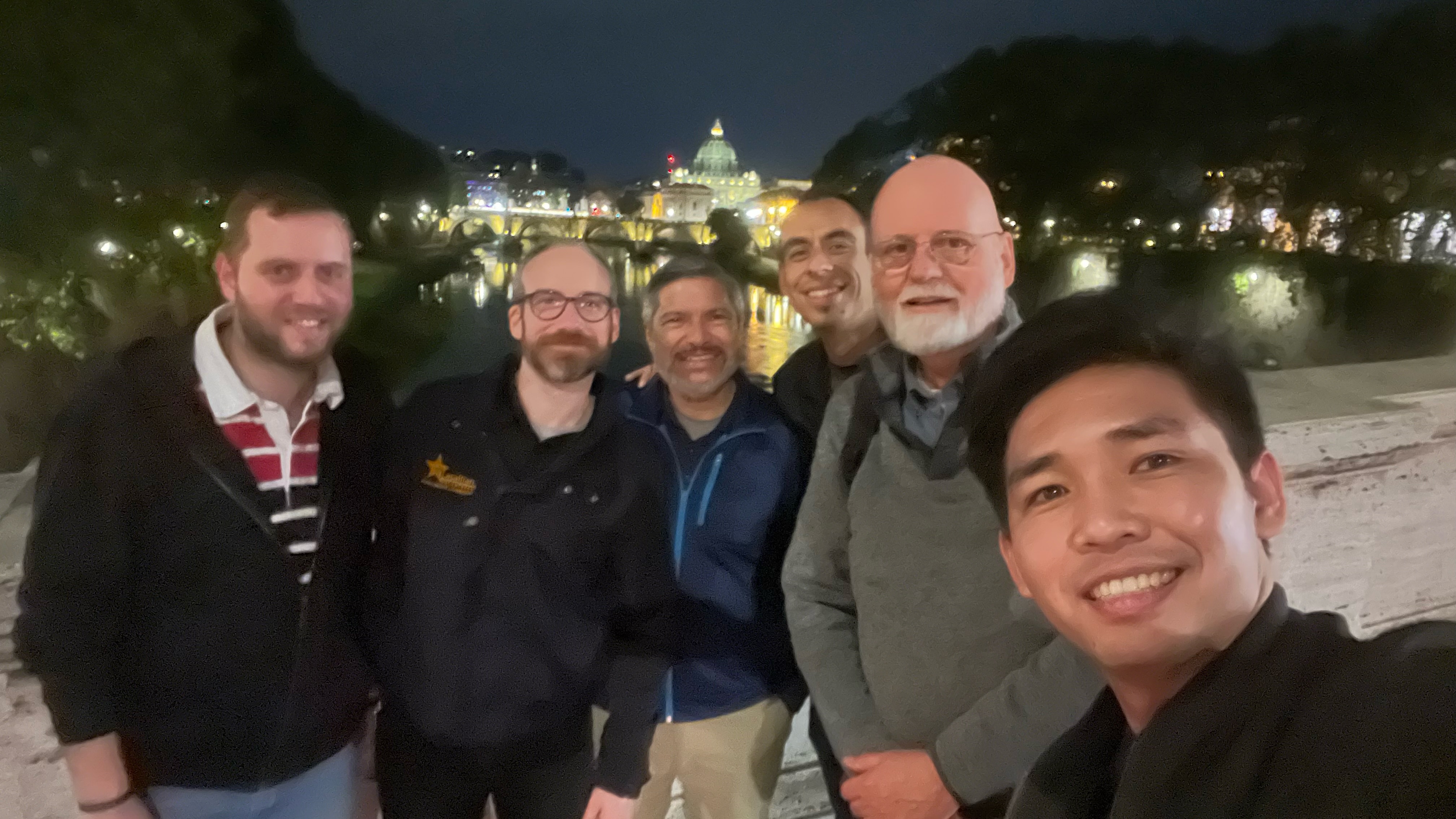
It's 12:15 am (on May 8th) and I've just returned from a very nice evening with some of the Brothers here at the Chapter. It's too late to relate the events of this day. Tomorrow is a "break" day. I've signed up for the trip to Assisi. Therefore, I'll do a double-duty blog post tomorrow and fill folks in about the events of the two days. For now, here is a photo of the group from this evening.

(Group photo with the Vatican and Tiber in the background.
LtoR - Brs. Louis, Dylan, Nick, Chris, me, and Luke))

Okay. I'm back. It's a day later, but I'll complete this day's blog with the information from the day. As all the other days, it was chockfull of listening, speaking, conversing, and processing. The theme was "Discover - The Life of the Brothers."Our morning speaking was Br. Eric de Clermont-Tonnerre, O.P., a Dominican theologian, formator (homiletics), former provincial, and author whose current specialty is working the laity. 

His talk was rather dense and even more scholarly than yesterday's. I took a lot of notes just to keep myself engaged enough to pay attention, althoug it's always hard for any translator to convey sophisticated theology French, rapidly delivered, into comprehensive English ideas. His focus was on "Fraternity" and community. He provided philosophical and theological background about what that means. "By being, living, thinking, working and celebrating together in diversity, we become community. It aslo depends on the circulation of the living Word rather than just doing things together. ... Every act of living together is not only a gift but also a task. Facing that which disappoints us in 

living together, it’s important to persist if we have Jesus ahead of us." He suggested that each of us do "a personal inventory of powerful experiences of fraternity in your life, whether dramatic or more quiet" because we will find out where our solidarity is truly exercised.

The most interesting bits for me happened during the question period. Question: In a religious institute in which we share a charism between religious and lay partners, what structure of criteria do we have for fraternity? Answer: "The religious vows are something that are established by an institution. The second case is newer idea. You have to be very clear - built and structured together by rules or documents that can give meaning to the mission. What’s most important is that this collaboration must be real; there has to be a real shared responsibility. And the fraternity experience is something that is recognized and celebrated. It is a fraternity that has to be concrete, human, and spiritual all at once." I would say that there weren't really any surprises or major revelations. It was an opportunity to think about what fraternity and community meant in our context.

When we gathered again at 3:00 pm for the report from the Secretariat for Assocation (Br. Paco and Heather Ruple Gilson), we found a paper bag with our names on it at our desks. We were used to finding little gift trinkets from various regions or districts at our places, and I'd left copies of The Teacher's Saint and the SRRL booklet prior to my presentation, but this was the first time that there was a paper bag full of a wide variety of things. When we tries to peek in, Br. Paco would say from the front, "Do no open the the bag!" in three languages. Most Brothers complied. In the ten minutes before the session, when Brothers trickled into their places, it became a mantra in the room ... sort of like those in Rome churches, or the Sistine chapter, who every once in a while loudly proclaim: "Silencio!"

When the become, the presentation was very interactive, from the seeds (there were 67 small seeds and a slightly larger, darker seed in each package, representating the 67 to 1 proportion of Partners and Brothers in the ministries at this time), to a small handout showing the "ghosts" of association (all the hidden assumptions peopel have about taking association seriously) to a really fine series of suggestions about what a next step might look like), to a sparkler that illustrated the impact good formation could have, and so on. The presentation was tightly scripted, in the good sense, really engaging, and include most of Howard Gardner's multiple intelligences in some way or other. The point that was made was very strong, appropriate, and well contextulatized. It may be summarized, for me, in Heather's statement: "We ask you to trust us as we move forward. ... I offer you an invitation as a persone with de facto association - all of those who have a deep level of commitment and vocation. We are waiting. We are waiting to set out to unknown islands and venture further in our journey of mission and association. Join us. But we need both. We need actions and structures. We need to be empowered so that we can accompany each other in furthering the mission." This was a bold proposition to Lasallian stalwarts.\

From the questions and comments that following the presentation , a period that had to be extended into the next activity, The questions - condensed by me - include: What do you want from us? (Answer: Approve the proposals of the AIMEL, which has been done, and to trust the AIMEL process.) Shouldn't this Secretariat be split from "mission"? (Answer: It hasn't been a problem and may be an advantage. Also This chapter has a real opportunity to reimagine the central government. CIAMEL has some wonderful people. Can we reimagine the Secretariat structure that really meets the needs of mission, formation, and Young Lasallians.) What are your biggest fears with regard to association? (Answer: My fear is not enough formation for lay people. It’s not consistent. // One of my fears is that it is too late in some parts of the Institute to shore up the mission there? A second one is that Brothers will continue to make decisions for lay people, assume things about the Lasallian vocation, about lay people, rather than inviting us to learn things together.) What is meant by "intentional communities". (Answer: "When we speak of intentional community. We are not advocating mixed communities. The founder knew that the only way was to bring teachers into his home. That’s going to look different now. I’m not able to live in a community, but I need to get together with other Lasallians, to pray with the Brothers, etc. Invitation and bringing lay members to the table is a start.) Some Brother comments: "The force of association and mission is great, but we have to talk about our life as Brothers also.". "The center doesn’t mean Rome, it means centers of excellence where expertise exists. We need to think about what the organization will really look like." "I don’t know all the structures that need to change. But I do know that structures for partners were created to replicate the ones for the Brothers. I don’t think they are no longer effective." The conversation was rich, thought-provoking, honest (mostly), and helpful.

As in the previous days, we then proceeded to our language sub-groups Marketplace sessions. The ones group I was in went to the International Strategy Group committee presentation and the one by Solidarity, the charity arm of the Institute.

The ISG presentation and discussion looked at the proposal for funding the retirement needs of Brothers in countries that don't have a social security system or the like. It was sobering and well-supported by the research. Some of the details of the proposal - such as how to exactly build the fund - were subjects of discussion. But I don't think that anyone doubted the wisdome of the committee to proactively prepare for the legitimate needs of Brothers who will be retiring and/or in need of healthcare in the next seven years and beyond.

The Solidarity presentation was very well prepared and presented, with brochures, overviews, time for questions, and a clear vision for the future. In the last seven years, Solidarity has distributed over 40 million Euros to a wide variety of needs throughout the Lasallian world, and do so with very minimum administrative costs - certainly less than virtually all other major charities. Their effecitveness and flexibility in terms of timely needs is very impressive. And their proposals for future support were realistic and reasonable. As a Brother sitting next to me make the observation that the "team" for Solidarity included four very competent women, which was unique in the presentations so far. Brother Amilcare also described the office style as fully collaborative, with weekly meetings and honest input on the part of everyone. It's certainly clear that whatever combination they're using is working well, and that others could / should learn from it.

After the two sessions, some of us stuck around to create the expected poster that highlighted the major words and thoughts that the group noticed. This would be hung up in the main corridor for others to see. 

Mass in language groups then followed. The English-speaking group met in the Trinity chapel downstairs - the one that the community uses - and it was a fine liturgy with familiar English hymns and great participation. Later, I was invited to join a group going to dinner and was happy to do so. It's one of the really nice opportunities at a General Chapter to spend time with other delegates outside of planned sessions and meetings, of which there are a lot! A thoroughly enjoyable evening ensued.


Friday, May 6, 2022

May 6, 2022 - General Chapter 46

Although it was again a very full day, I would also say that it was more subdued. The title of the day was "Discovery - Leadership" and it began with a presentation by Sr. Rekha Chennatu, RA (Assumption Sisters) with the title A Synodal Leadership Paradigm: Insights from John’s Gospel. She was a sister from Kerala India who had been Superior General of her order for 14 years and was also a Vatican-ratified Scripture scholar whose specialty was the gospel of John. Her style and approach were radically opposite to that of Fr. Massingale. Her delivery was calm, scholarly, and mentally rapid - meaning that the thoughts and ideas came pouring forth like people exiting the Metro. It was hard to keep up because some ideas would have benefited from the occasional pause. But her notes were straightforward. I was reminded of my time in college, not negatively, just requiring a different kind of attention.

She spoke of John's radical ecclesiology of covenant friendship in leadership. Servant leadership is fine as far as it goes. But John's spirituality goes deeper and wider. "We are called to life another way. We need to create communities of friends, covenant partners. That would bring about radical changes in our communities." This was illustrated by an exegesis of the Good Shepherd discourse, the foot washing by Jesus (which was John's symbolic representation of Jesus on the cross; i.e., the most powerful representation of God's love), and the commisioning of Peter (Do you love me more than others; more than these material things; more than you love your ministries or functions?) Therefore, "One can reasonably conclude that Jesus inaugurated a new community of participative leadership." Her general insight? The Johannine model invites people to contribute all their talents - leads to collaboration and reciprocity in leadership roles. This is the synodal way - each member has a different role and functions in the building of the community - not related to superiority and inferiority.

While not the most dramatic of presentations, the content was solid, which the questions confirmed. One example: Who has the decisive vote in the community of equals? (Answer: I encourage everyone to speak their mind. Every member has the freedom to express her / his views clearly, with conviction, and with reasons, and why they say what they are saying. Once that is done, we must be detached from our opinions and ideas and listen to those of others from THEIR perspectives. And if, after that, there is no consensus, then we need more time and space until we come to a consensus.) So you get the idea. Her knowledge of John came out during a question about women leadership in John. Immediately, she highlighted the women in John's gospel and how they were leaders in their communities: Mary Magdalene, Mary the mother of Jesus, Martha and Mary, ending with Mary Magdalene again who didn't give up but remained at the tomb looking for Jesus, while the disciples left the scene.

One thing that stood out to me was her response to a question about the likely resistance to the leadership model in John's spirituality. She said, "The Johannine model is the friendship or synodal model of leadership, invited us to deal with one another as friends. It makes a radical difference to relate to one another as friends. Resistance, being comfortable with the way that we used to do things, shouldn't be in our vocabulary. We need to break that chain. When we keep saying that, we are really killing the charism. We are not allowing the charism to come alive in new ways. And it can no longer be leaven. We need to leave our comfort zones and embrace this vulnerability of resistance, recognize it, and slowly we will be able to respond creatively through our openness. It may not be possible by ourselves, but when we do this together and with God, it can become a graceful experience for all of us. Leadership is all about the power of love, all about friendship, all about sacrifice, all about assuming responsibility today, and moving forward in accomplishing God’s mission." That's a long quotation. But it's a perfect illustration of the fact that while her delivery was nothing to write home about, the substance of what she said had real value.
Before we stopped at about 12:30, Br. Jorge made some announcements, among which was a recognition from the central commission that they had not followed the proper procedures in the consideration and voting on the acceptance of the AIMEL proposals yesterday, having failed to include a time for discussion - a decision that the moderator for the session had made because of time constraints, although there was nothing in the manual of procedures for that option, and also for not recognizing the attempt of a member of the Chapter to make a point of order to that effect at the time. You can guess who that member might have been. As with any legislative process, the kinks gradually straighten out, and the proposal would have passed nevertheless. But it was appropriate to recognize that a public discussion of this rather significant proposal had been left out, and in my opinion, based on how I read the assembly, it is still needed. It will almost certainly emerge through other means in the process ahead.

In the afternoon there was a report from the Econome General. The details were for the Chapter alone and confidential to that group. Therefore, all I will say is that it provided the broad outlines of the current fiscal situation of the Institute and the Casa Generalizia, and that there was a long question period that followed, all of it well handled by the Econome General. The Moderator extended the question period into that of the next activity, but the schedule was accommodated to allow for that.
Now there were two more Marketplace sessions. My language group was ENG2 and we went to the presentation on the Secretariat for Formation, followed by another presentation in a different location that covered CIAMEL and the Secretariat for Association. Both were well planned and very informative. The formation one had Br. Rey, Br. Luis, and Br. Sylvain make separate presentations in English, Spanish, and French, which effectively illustrated the breadth of the Institute's formation audience. Those who did not know all the languages could follow along in the brochure that was handed out. As always, the question period was the most engaging part. 
The CIAMEL and Association presentation was equally rich. One of the comments that stood out for me was that the publications that have been provided are good and helpful, but it would also be great to have specific formation programs in Rome for school leaders. Another person suggested some kind of pedagogical handbook - similar in intent as the Conduct of Schools - that would help teachers become better teachers. All in all, it was a very helpful and positive session. In the group reflection session that followed, I appreciated the comment that our conversation around "Association" and how to best handle that among our Partners, perhaps coming up with a new word or process or sets of characteristics, was one that has so far been pretty much done from the perspective of the Brothers. With the best of intentions, the Brothers have worked at developing this understanding. Wouldn't it be more appropriate if the Partners themselves were the ones to develop their understanding of that reality through their own experiences, language, conversations, and discernment? (I'm not saying this as well as the person who brought this forward, but the point is clear.)
Earlier in the day, I had agreed to go out to dinner with Br. Chris Patino and Br. Guillaume Yame from Togo, working in Benin. He is one of the secretaries for the Chapter. We left at 7:00 pm and emerged from the Metro at Ottaviano station in a torrential rain. Luckily, the restaurant was not far away, and we proceeded to have a very nice dinner and doing what Brothers usually do on such occasions; i.e., solve the problems of the Institute. Since Guillaume had never been to Rome before, we walked to the semi-empty Vatican afterwards, which of course was very impressive to Guillaume (and to us also; it never fails to impress). After some photos, we made our way back to the Metro and thus back to the Casa Generalizia. Another full day, but nicely ended.

Thursday, May 5, 2022

May 5, 2022 - General Chapter 46

You may not have had this experience, but today I was reminded that sometimes what we've lost is actually rather nearby. The ticket that was hidden behind a credit card in your wallet, the receipt that was in the drawer of your desk, or the favorite shirt that was in the laundry basket - maybe these are things that older folks experience. But the point is that earlier I wrote about the Superior General's talk, and how I would just summarize things because I didn't have a copy, when all the time a copy was very much available right HERE. That's the place to get all the latest information, photos, and media.

Today, there was a "main event", the report from AIMEL, and the start of the "Market Place" sessions. All three were noteworthy for different reasons. The main event was the presentation by Fr. Bryan Massingale, a diocesan priest from Milwaukie who is an ethics professor at Fordham and very well known throughout the country for his passion, erudition, connectivity with students, and exemplary teaching style. He was introduced by Br. Ernest Miller, who shared a long list of  Fr. Massingale's accomplishments, and recognitions. When the welcome was finished, Fr. Massingale came down and spoke to us from the front of the podium because he was a teacher and wished to move around as he spoke to us.


His first statement to us set the theme: What does it mean to be a courageous sign of hope in a time that does not know how to name itself? Using Pope Francis' quote “We are not living in an era of change, but a change of era", he proceeded to describe an existentially different time of living today, one that calls for courageous venturing into the unknown. A list of all the ways that the world is different - climate change, deep questions about sexuality, rising nationalism, the pandemic, etc. - became immediate when he showed two photographs, side by side. One was a Brothers community in North America (mostly older, white-haired, Brothers, some smiling, sort of) and the other was a Brothers community in the Southern hemisphere (none white, largely young, no grey hair, very much smiling). He posed the questions "Whose Institute is this? Who really belongs? Who counts?"

I very much liked a quotation that he used from Pope Francis' talk to priests and religious in Mozambique in 2019, because it applies so well to our current situation: "Whether we like it or not, we are called to face reality as it is. Times change and we need to realize that often we do not know how to find our place in new scenarios: we keep dreaming about the ‘leeks of Egypt' (Num 11:15), forgetting that the promised land is before us, not behind us, and in our lamentation for times past, we are turning to stone.” From there, he spoke about the virtue of courage, which according to Aquinas is the precondition of all virtue, It is the fortitude to endure hardships and fear for the sake of doing right in the face of injustice, translating convictions to actions. You need courage to dwell in the peripheries. And you need hope: the inner orientation of the human spirit that sustains one in the quest for a non-guaranteed future in the face of formidable obstacles. Plus you need "gnome", which is the ability to reason well in the exceptional situations that are not covered by the common rules of action. And finally you need YHWH, the Divine Mystery for which the word is in the future present tense - a tense that is not in English; - a presence that mysterious, dynamic, passionate. "Behold, I make all things new."

Let's hope that his presentation is uploaded to the Chapter website linked above. It's really impressive when someone can be both passionate and erudite, down-to-earth and deeply grounded in theology, passionate with us and empathetic to our priorities. At the end of his talk, it received the most sustained applause of any presentation or talk so far, and for good reason. After a break - during which I gave him a copy of my little book on De La Salle since he said that he'd learned about him mostly on the internet - there were some excellent questions, followed by excellent answers, all challenging and insightful. Example question: Can an organization as large as ours make radical changes, or does it require something very new? Part of his answer: "Yes! As an organization as large and global as you are, you need to make space for creativity and the experimentation to move into new frontiers and new places. Don’t stigmatize people who are doing so. ... We made changes in the past; we have a history; the spirit is ever new and ever creative." Another question: How should an all-male congregation address the LGBTQ issue considering that our young Lasallians and Partners are grappling with this too? Part of his answer: "First, we have to be honest about how the question makes us uncomfortable. It makes us uncomfortable because as religious men, our religious life makes us already suspicious and uncomfortable about how we live masculinity. By definition we are unmarried, and educators, called to be compassionate and sensitive. ... [And] we have to understand that we are called to a prophetic understanding of masculinity. We are called to the masculinity of Jesus, who at Gethsemane needed his friends to be with him, who allowed John to rest his head on his chest, who was not afraid of human touch (women washing his feet) and washed his disciples feet." In answer to another question, he spoke about what we can learn about other international organizational that have gone through different models of change, recommending John Quinn's book, Deep Change. There were other questions about conservative young people and priests, the goal of "radical availability" on the part of the Brothers, etc. The time moved quickly and 90 minutes were done in a flash. The session ended by Sr. Leslie leading us through an "important words for us right now" exercise using an online program that displayed the words we wrote on the "menti" website on the screen in a word cloud. The largest word was "courage".

We next came together again at 3:00 pm, when Alisa Macksey and Br. Nestor presented the results of the first phase of the AIMEL gathering. There was a bit of earphone juggling on my part, because Alisa spoke in English and Nestor in Spanish, taking alternate turns at reading the sections of the eight propositions from AIMEL. I needed the earphones for Nestor, but if I didn't take them off right away, or go to another channel when Alisa came on, there would a French translation in my ear. But most of it got through.

The question period was quite varied and serious. The propositions brought up all sorts of issues and concerns. Examples: Who gives the stamp of approval to the final document from AIMEL that will be created at the second session? (Answer: The hope is that we would entrust the delegates of IAMEL with the final approval.) Who does the implementation of the document - Rome, Regions, Districts? (Answer: It would be the work of CIAMEL with the next General Council and work with Districts on the implementation.) Are there discussions or specific proposals with respect to the General Chapter itself? (Answer: We’d like the General Chapter to contribute some possibilities to add to our second phase: comments and input. There was a brief discussion by AIMEL as to whether to have a joint meeting of AIMEL and the General Chapter in the future.) What do you want from the General Chapter? (Answer: We hope that things that are in line with your proposals would be incorporated into your own decisions.) Is it your intention for this CIAMEL to have some sort of deliberative authority? It seems to include a bold shift in empowerment. (Answer: We would like CIAMEL to be empowered to make decisions in dialogue with the General Council without necessarily requiring approval for every decision made.) A few "questions" were more in the nature of opinions. But generally the questions were thoughtful and focused. A proposal was offered from the central committee of the Chapter, regarding the acceptance and validation of the AIMEL proposals. It was written in language that was carefully nuanced and supportive.

When it came to the voting itself, the Moderator for the session pointed out that this would be the first actual Chapter Act to be voted on. A hand-count of the voting delegates was done by all the scrutineers, which yielded 66 voting delegates in the room. The vote was then taken electronically. The total votes recorded was 71. A bit of a problem here. The vote was retaken, and this time 65 people voted and 56 votes (53 positive and 3 Juxta Modum, which count as positive). General applause followed, and the session ended, with many going up to the front to congratulate Alisa and Br. Nestor for their work and its validation by the Chapter. One procedural concern on my part was communicated to the central community afterwards, via a quick email from my room prior to the next activity, but its neither necessary nor helpful to bring it up here. I was happy that the work of CIAMEL and AIMEL was understand, accepted, and brought forward.

After this, there were Marketplace sessions in different locations on the property. Those in my language subgroup, mentioned in an earlier blog, went to the Young Lasallian and Young Brothers presentations. Br. Dylan Perry showed several videos prepared for the occasion which succinctly shared the results of those gatherings, after which he had us highlight with post-it stickers which ones we thought had already been done well or not been accomplished yet. It was a clever way to get a pulse on where the group stood.

The second Marketplace session focused on the "Notes" that the Brothers had sent to the Chapter, only 100 in number. The presentation provided a summary of those notes and began a longer discussion of what we had learned during the day's events and what we wanted to "privilege" as we moved ahead. It was a very good group conversation.

Today's activities finished at 6:43, seven minutes before Mass in the main chapel. A quick run to my room and then to the chapel, where the Mass would be in English, with Fr. Massingale as the main celebrant. I had volunteered to sing in the choir and therefore was busy with that for most of the Mass, although our point of view was rather limited.

During dinner, I sat next to Br Alvaro Rodriquez Echeverria, the former Superior General from Costa Rica, who was a "by right" member of the Chapter. We had a fine conversation about many things, including the 2007 Chapter when he was reelected and I was overseeing the liturgies and prayer. We're both a little older now. After dinner, I popped down to the Den and found a find bunch of folks enjoying themselves. It was a nice place to relax for a while before heading upstairs to write up this blog post. Before leaving, I took out my phone and asked for a photo for the blog. People were happy and willing to do so. Below is the result. A very busy day once again, and a noteworthy one.


Wednesday, May 4, 2022

May 4, 2022 - General Chapter 36

It already seems like we have been meeting for several weeks. Now that the retreat days are done, the planned process has begun and the schedule is tightly configured. The Superior General's report this morning was the main event. He told me that he thought that it would not fill in the time given for it - 90 minutes - and he was right, except that part of that time was to be given over to questions and comments.

The presentation itself was about 45 minutes, and it was really excellent. He started by quoting Ephesians 4:23 about putting on a new mind and asked what it meant for us at this moment in the history of the Institute to "procure God's glory" because that is what we have consecrated ourselves to. We joyfully proclaim God's glory through the ministry of education. We must not forget why this charism came into existence, and we must realize that we inherited that charism, one that always exceeds our expectations and our cautions. It is a charism that witnesses to Jesus and his project for the reign of God.

The talk went on in that vein, and it is well worth reading once it is publicly made available. Listening to it was like a spiritual rally - a sort of political rally without the fuss and noise and confetti - touching lots of echoes in the heart and articulating all those things that first attracted you to this Lasallian vocation and that keeps you in it. In one section, he said, "Brothers, we too are called to be men of the spirit. The renewal of the Institute will become a reality to the extent that we give ourselves to spiritual renewal. Each Brother is invited to renew himself spiritually. This won’t happen without knowing that we are loved. ..." He also highlighted the new realities of today: "Our world has changed in these last two years. What meaning does a changed world have for us? ... It is time to realize the dreams of past chapters ... Reimagine who we are and for whom we are as followers of Jesus Christ." And in terms of the expectations for this General Chapter, "We don’t expect that Chapter to offer a definitive governance model in these three weeks, but we do hope that it provides clear direction for developing a model by the next General Chapter." These are only little nuggets that I managed to write out almost verbatim, but it gives you a sense of the message. He also repeatedly urged us to be aware of the fact that while there are few Brother vocations, the Holy Spirit has given us thousands and thousands of Lasallian vocations. What does that mean? How do we read that for our lives and our future?

After the talk, there were some questions and some comments, a number of them highlighting the organizational realities and responsibilities that were part of our educational scope today. One of his responses stood out to me, although it's not exactly verbatim; "Through dialogues and discussion, I am convinced that we can move toward new models. ... I wonder if we have been offering models to our Partners based on religious life structures? I hope that we come up with a model whereby Brothers and Partners share responsibility for the mission." He highlighted some of the ways that France and ARLEP have responded to their realities and have shared responsibility for the mission with their Partners, and Brothers made reference to synodality. One asked, "Are we really enriching the entire Lasallian world in terms of the charismatic path, or are we just maintaining the mission?" Here I'll stop putting down quotations. Just know that it was one of those genuinely engaging exchanges that are as rare as they are rich. At the end of the 90 minutes we deserved a break and took it.

The next person on the agenda was me; my fifteen minutes of fame, as it were. The report was going to be on the Lasallian Research and Resources Service, for which I am the "Secretary/Coordinator" - a rather strange title, but okay. For the last couple of weeks, I'd been working on the talk, figuring out ways to keep it informative but also appealing. The text was written out, with cues for the Powerpoint pieces, and timed to the minute. I'd figured out a way whereby a smaller corner video could run across multiple slides, allowing me to make my points while a silent walk-through video of the various locations ran in one corner of the slide. I had also made copies of the text, with DeepL.com translation copies in French and Spanish, to be given to the translators in their booths. They would certainly appreciate the English text I was going to use, but perhaps they's like the pre-translated ones as well.

People seemed to be quite happy with the result. After the applause, as I was walking back to my seat carrying the laptop with its dangling power cord and clutching my text, all the Brothers I passed or caught my eye gave me the thumbs-up with a wide genuine smile. And for most of the day, Brothers I know well, and some I don't, have come to let me know that they really appreciated the presentation. We had also prepared a booklet about the SRRL (the acronym, in French, for our Service) that we placed at each seat during the break, in the language of that particular person, along with a copy of "The Teacher's Saint" in the same language. And so I think that everything was well covered. The talk would make them interested in reading the booklet, and my "observations" during the presentation may help advance the interests of this Service. A couple of folks asked for copies of the Powerpoint, but it was simpler to record the Powerpoint and then put it on YouTube. (HERE)

The Communications Service followed my presentation, and Br. Alexander did a fine job of explaining all of the work that his staff does to ensure publications and communications on all sorts of media. (#FSC46GC is the hashtag to use on Twitter, although I'm not a Twitter user.) One of the guests sitting next to the Superior General was Br. Ernesto Sanchez, the Superior General of the Marist Brothers. He also spoke to the assembly with kind words, recollecting times when groups he was associated with had used that particular hall, and identifying with many of our concerns and priorities. Then everyone went off for a short break before lunch.

At 3:00 pm, the usual time to resume things in the Motherhouse, we gathered in language groups in different rooms to answer one or more of some questions that would begin our discernment journey. The process for the group - there were two English language groups of about 16 people - was that first four people would converse for 30 minutes, then two 4-person groups would come together for 30 minutes to share their results and continue the conversation, and then the whole group would come together for another 30 minutes to consolidate their thoughts which the Secretary for the group would report on afterwards. The question that our small group chose was "What challenges have been met during this seven-year term that have had the greatest impact on you?" By the end of the 90 minutes, we were rather tired but had raised a number of things that we appreciated and things we were concerned about. (Not enough time or space to cover these here.) It should be said, however, that various works of direct service of the poor such as the Fratelli project and the Beyond the Borders projects were repeatedly mentioned as examples of where charismatic life seems to be most evident.

We finished at 4:30 and had a short break before returning to the Aula Magna at 5:00 pm for our group reports, which took about an hour. After that, there were questions and comments from the floor, and Sr. Leslie, our facilitator, provided her comments, very impressed with the deep and bold thinking that had been expressed. In effect, she said "The touchpoint in the center of the table is charism, which will move us - some things will fall away and others move forward; but that charism rekindles our passion. Be encouraged; there is alot of to be proud of here; these examples have given you much support." Then there were announcements and instructions for upcoming events, so that by the time we left the Aula Magna it was 6:34 pm - Mass would start at 6:45 pm. But it started on time, and I think many people were relieved to be somewhere where they didn't have to do anything but pray.

Tuesday, May 3, 2022

May 3, 2022 - General Chapter 46

 Bear with me while I take a mental breath. Although today was a retreat day, and the schedule was simple and straightforward, the rich input that we had reminded me of the Far Side cartoon where the student raises his hand and asks to be excused because his brain is full. Today's talks were a kind of spirituality equivalent of that, at least for me.


Sr. Maria Cimperman from the Catholic Theological Union in Chicago was our presenter, and there were two presentations, one at 9:00 am and the other at 3:00 pm, both about 90 minutes long. Her experience as a professor in social ethics and a female religious were both evident in the things that she shared with us. Her style was conversational, which was really helpful, but her material was both challenging, deeply grounded, and very thought-provoking. I took over six pages of notes on my laptop, highlighting some things as they struck me as important.

The flow of thoughts, connections, and images were something like a symphony, which you can appreciate on any number of levels; melodic passages, interesting harmonics, exciting rhythm here or there, long thematic stretches, and so on. If you can imagine that on a verbal/mental/reflective level, you will also understand that it's useless to try to share its content here. All I might attempt is to share some of the statements or questions that captured my attention as something I'd want to think some more about.

- There is the hermeneutic or serendipity. When you think you are settled somewhere, surprises happen that call for new pathways, new thinking, different approaches from the past.
- (One part of the General Chapter's theme is transforming lives.) Consecrated life is also in need of transformation, interior conversion. "Trannsfoming lives includes your own. It must."
- Religious life doesn't own the charism; we embody it and seek to live it. The charism is a gift of the Holy Spirit, which means that it is brought forth in creativity and freedom. It's given for particular needs, always grounded in God. We're not called to be NGO's but to be the Good News.
- The title "Brothers" speaks to the loving tenderness of relationship that your Founder of and is in your documents. You witness what it means to be a male religious.
- She quoted from and expanded on a Canadian theologian's thinking about seven cautions or challenges for religious orders who engage in a "transformation" process: we make new improved versions of the past; we think we have to try harder rather than think differently; we play it safe rather than innovate; we engage in polite incremental change rather than vigorous and deep transformation; we exercise avoidance rather than creation; we download the same information and put it in another Excel form, not shifitng our consciousness; and we focus on external work rather than inner work.
- Where are our new peripheries? Where is the charism calling us now, today? What message of Jesus does God want to speak to the world today through the Institute?
- By their nature, the Brothers go to the peripheries (she used quotations from the Rule throughout her talks.) "You have the periphery at the center. They are your focus. The question is, if that's your center, where are your next peripheries? They may very well be the existential ones. ... What is calling next?"
- The need is for process more than structure. A pathway isn't a building. It's not concrete. It will be far more organic, and you will walk this way. The richness comes from listening, listening long and hard.

By now you're either a little bored or just trying to figure out how all that ties together. Did I mention that the talks were hard to summarize? I just know that several times I wanted to hit the Pause button, so that I could think through something that was said, either by the presenter or by one of the Brothers during the open response times. But I think that it was the overall impact that was her focus, which was to help us to contextualize the riches that we carry, become increasingly aware of our present realities as opportunities, and motivate us to trust in the Holy Spirit's dynamic in the existential realities of the present and move forward in a way that aligns with our foundational (think Heroic Vow) and Gospel priorities. In some ways, her talk was like a collie herding sheep, getting the group to move in a direction that was being guided by one whose perspective was outside of our own immediate minutiae of life. I'm not sure if I enjoyed the whole experience, but it certainly was rich with potential and meaning.

When we weren't in the talks, we were supposed to be reflecting on questions that were give out at the end of each session. And I'm sure that many people did that. In my own case, I had a number of things happening in my Secretariat and needed to be there for most of the day. Plus, tomorrow is the day for my short 15-minute presentation to the Chapter about the Lasallian Research and Resources Service. I'll let you know tomorrow how that went.

By the time I had finished my work, Mass had started, and so I arrived late and remained in the background. But there was a nice photo from that angle, however. Just looking at all the Brothers present there, from all the countries where we have ministries, it was impressive to see that inter-culturality (one of the strengths and catalysts of transformation according to Sr. Maria) was clearly and quietly on display. We are just at the beginning of our time together, but already the strong sense of common mission and community provides assurance that we may do some rather good things here.